
As an Amazon Associate, I earn from qualifying purchases.
A small kitchen can feel crowded before you even start cooking. One coffee maker, a dish rack, a few spice jars, a cutting board, and one pan left on the stove can make the whole room feel messy. If you live in an apartment, condo, studio, rental home, or older house with limited cabinet space, you probably know how quickly a tiny kitchen can feel overwhelming.
But the size of the kitchen is not always the real problem. The bigger issue is usually wasted space.
Most small kitchens have hidden storage opportunities that many people overlook. For example, cabinet doors, vertical walls, deep shelves, narrow gaps, drawer corners, under-sink space, and even the side of the refrigerator can work much harder with the right system. In addition, you do not need a full remodel, custom cabinets, or a large walk-in pantry to make your kitchen more useful.
The best small kitchen storage ideas do three things: they free up counter space, make daily items easier to reach, and reduce visual clutter. As a result, your kitchen can look calmer and feel bigger. Also, storing tools where you actually use them makes cooking faster. When every item has a proper home, cleaning takes less time.
This guide is designed for real small kitchens, not picture-perfect showrooms. These ideas work for renters, busy home cooks, tiny apartments, narrow galley kitchens, and anyone who wants a cleaner, smarter kitchen without spending thousands of dollars.
Quick Small Kitchen Storage Ideas by Problem
| Small Kitchen Problem | Best Storage Fix |
|---|---|
| Counters always look messy | Keep only daily-use items on the counter |
| No pantry space | Use clear bins, stackable containers, or a slim rolling cart |
| Deep cabinets are hard to use | Add pull-out shelves or sliding baskets |
| Drawers are cluttered | Use adjustable drawer dividers |
| Too many appliances | Store appliances by frequency of use |
| Cutting boards and trays fall over | Store them upright with dividers |
| Under-sink area is messy | Use two-tier organizers or small bins |
| Kitchen feels visually crowded | Use matching, light, simple storage |
1. Clear the Counters First
If your small kitchen feels tight, start with the countertops. Counters are the most visible part of the kitchen, so even a few extra items can make the whole space feel smaller.
A good rule is simple: only daily-use items should stay on the counter.
That might include a coffee maker, a small dish rack, a knife block, or a utensil holder. Everything else should be stored in a cabinet, drawer, pantry bin, rolling cart, or wall-mounted organizer.
This does not mean your kitchen has to look empty. It means every visible item should earn its space. A small tray with olive oil, salt, pepper, and your most-used seasoning can look neat and intentional. But ten random bottles beside the stove will make the same counter look busy.
Best for: apartments, rental kitchens, tiny kitchens
Cost level: free
Difficulty: easy
Rental-friendly: yes
Before buying organizers, clear the counter completely. Then put back only what you use every day. This one step can make a tiny kitchen feel bigger immediately.
2. Use Vertical Space Before Adding More Furniture
When floor space is limited, walls become valuable. Many small kitchens have unused vertical space above counters, near the stove, beside cabinets, or around the refrigerator.
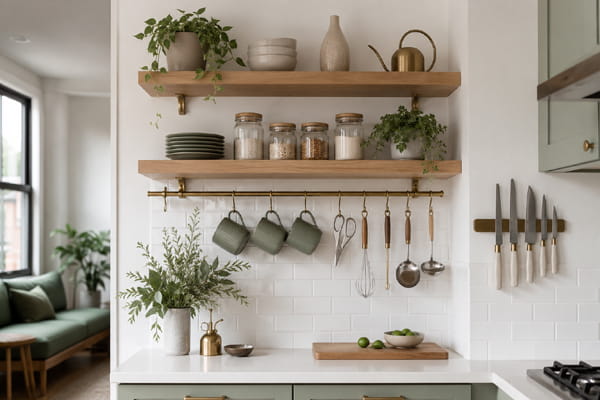
Wall shelves, magnetic strips, hanging rails, pegboards, and slim racks can free up drawers and counters without using floor space. This is one of the smartest small kitchen storage ideas because it turns empty wall space into practical storage.
A magnetic knife strip can replace a bulky knife block. A wall rail can hold measuring cups, mugs, towels, or cooking utensils. A small shelf can hold coffee supplies, spices, or everyday bowls.
However, vertical storage should be used carefully. If every wall is covered with tools, the kitchen can feel busy. Use vertical storage for items that are useful, attractive, and frequently used. Hide the rest behind cabinet doors.
Best for: renters, narrow kitchens, galley kitchens
Cost level: low to medium
Difficulty: easy to moderate
Rental-friendly: yes, if using removable or no-drill options
The goal is not to display everything. The goal is to create breathing room.
3. Make Deep Cabinets Easier With Pull-Out Storage
Deep lower cabinets often look spacious, but they can be difficult to use. Items get pushed to the back, pots become stacked too high, and cleaning products disappear behind pipes or bulky containers.
Pull-out organizers solve this problem by bringing the back of the cabinet to you.
You can use pull-out shelves for pots and pans, sliding baskets for pantry items, or under-sink drawers for cleaning supplies. These organizers make it easier to see what you own and reduce the need to dig through dark cabinets.
For renters, choose no-drill pull-out baskets or freestanding cabinet shelves. You can place them inside existing cabinets and take them with you when you move.
Best for: deep cabinets, lower cabinets, pots and pans
Cost level: medium
Difficulty: easy
Rental-friendly: yes, if no-drill
Pull-out storage is especially useful for heavy items. Instead of lifting several pans to reach one skillet, you can slide the organizer forward and grab what you need.
4. Use Cabinet Doors for Hidden Storage
The inside of cabinet doors is one of the most underused areas in a small kitchen. It is hidden, easy to access, and perfect for slim items.
You can use cabinet door racks for cutting boards, measuring spoons, pot lids, food wrap, foil, cleaning cloths, or small spice jars. Under the sink, a door-mounted organizer can hold sponges, gloves, dish soap, or trash bags.
This idea works well because it adds storage without adding visual clutter. When the door is closed, everything disappears.
Best for: small tools, pot lids, cleaning supplies
Cost level: low
Difficulty: easy
Rental-friendly: yes
Just avoid storing heavy items on cabinet doors. Too much weight can damage hinges over time. Lightweight items are best.
5. Store Cutting Boards, Trays, and Baking Sheets Upright
Flat kitchen items are awkward when stacked. Cutting boards, baking sheets, muffin pans, cooling racks, trays, and pot lids can quickly become a messy pile.
The better solution is to store them upright.
Use a vertical divider, file organizer, or narrow rack inside a cabinet. This turns flat items into a filing system. You can pull out one item without moving everything else.
This small change can make a big difference. It saves space, protects items from scratches, and makes cooking faster.
Best for: baking sheets, cutting boards, trays, pot lids
Cost level: low
Difficulty: easy
Rental-friendly: yes
If you bake often, create a small baking zone with sheet pans, cooling racks, parchment paper, and muffin tins stored together.
6. Create Kitchen Zones Instead of Random Storage
A small kitchen feels more functional when items are stored by activity. This is where many people lose space without realizing it. They store items wherever there is room instead of where those items are actually used.
Create simple zones:
First, keep cooking tools near the stove.
Next, keep prep tools near the cutting board area.
Finally, keep cleaning supplies near the sink.
Coffee and breakfast items should stay near mugs and cups.
Snacks should stay in one cabinet, bin, or shelf.
Baking supplies should stay together in one zone.
This prevents random storage. If your spatulas are near the stove, your knives are near the prep area, and your dish soap is near the sink, you move less while cooking and cleaning.
Best for: busy home cooks, family kitchens, apartment kitchens
Cost level: free
Difficulty: easy
Rental-friendly: yes
In a tiny kitchen, better flow matters as much as more storage.
7. Use Drawer Dividers for Small Tools
Drawers can become clutter magnets. Spatulas, peelers, measuring spoons, clips, rubber bands, bottle openers, and random gadgets can all end up in one messy drawer.
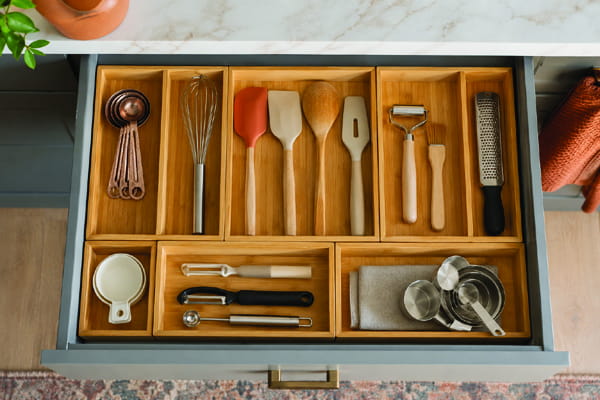
Drawer dividers keep small tools visible and separated. They also stop you from buying duplicates because you can actually see what you already have.
Use adjustable dividers for unusual drawer sizes. Use slim trays for shallow drawers. For deep drawers, use small bins or vertical sections.
Do not keep every kitchen tool in your main drawer. Keep everyday tools close. Move rarely used tools to a secondary drawer or storage bin. If you have not used a gadget in a year, it may not deserve space in a small kitchen.
Best for: utensils, measuring tools, small gadgets
Cost level: low
Difficulty: easy
Rental-friendly: yes
A clean drawer saves time every single day.
8. Use Clear, Stackable Containers for Pantry Items
Small kitchens often lack a real pantry. That means dry goods end up in cabinets, drawers, shelves, or rolling carts. Without a system, pantry items become messy fast.
Clear, stackable containers help create order. They work well for rice, pasta, flour, sugar, oats, cereal, coffee, lentils, and snacks. Because they stack neatly, they use vertical space better than half-empty bags and boxes.
You do not need to decant every item. Start with foods that spill easily or take up too much space. If a bag is messy, hard to close, or difficult to stack, it is a good candidate for a container.
Labels are helpful, especially for similar-looking foods like flour, powdered sugar, cornstarch, and baking powder.
Best for: no-pantry kitchens, apartment kitchens, dry goods
Cost level: low to medium
Difficulty: easy
Rental-friendly: yes
Clear containers also help you see what you already have before buying more.
9. Build a No-Pantry System With Bins
If your kitchen has no pantry, bins can create one.
Use separate bins for breakfast items, snacks, baking supplies, canned goods, sauces, tea, coffee, or kids’ lunch items. Instead of searching through loose products, you can pull out one bin and see the whole category.
This system works inside cabinets, on shelves, in a rolling cart, or above the refrigerator. Clear bins are practical because you can see what is inside. Solid bins look cleaner if they are visible.
The important thing is to avoid oversized baskets. Large bins can waste space and become cluttered. Choose bins that fit your cabinet depth and shelf height.
Best for: no-pantry kitchens, small apartments, family snacks
Cost level: low
Difficulty: easy
Rental-friendly: yes
Bins work best when every bin has one clear purpose.
10. Fix the Under-Sink Area
The under-sink cabinet is often one of the messiest spots in a small kitchen. Pipes make the space awkward, and cleaning supplies can pile up quickly.
Use a two-tier under-sink organizer, small drawers, bins, or a tension rod. A tension rod can hold spray bottles by their handles, leaving space below for sponges, gloves, dishwasher pods, and trash bags.
Keep this area focused on cleaning and dishwashing items. Avoid storing food, paper goods, or random household supplies under the sink, especially if the area can get damp.
Best for: cleaning supplies, dish soap, trash bags
Cost level: low to medium
Difficulty: easy
Rental-friendly: yes
A clean under-sink cabinet makes the whole kitchen easier to maintain.
11. Add a Slim Rolling Cart for Flexible Storage
A rolling cart can be a lifesaver in a tiny kitchen, especially if you have a narrow empty space beside the refrigerator, near a wall, or between cabinets.
Use it as a mini pantry, coffee station, baking cart, snack cart, or extra prep station. The best part is that it moves. You can roll it out when cooking and tuck it away when you need more room.
Choose a slim cart that matches your space. A cart that is too wide will make the kitchen feel more crowded.
Give the cart one clear purpose. If it becomes a place for random items, it will add clutter instead of solving it.
Best for: renters, no-pantry kitchens, flexible storage
Cost level: low to medium
Difficulty: easy
Rental-friendly: yes
A slim cart is especially helpful when cabinets are limited but floor space has one narrow gap.
12. Store Appliances by Frequency of Use
Small appliances take up a lot of space. Air fryers, blenders, coffee makers, toasters, rice cookers, mixers, and food processors can quickly overwhelm a tiny kitchen.
The best approach is to store appliances based on how often you use them.
Daily-use appliances can stay on the counter. Weekly-use appliances should be easy to reach in a cabinet or cart. Rarely used appliances should be stored higher, lower, or outside the kitchen if needed.
If you have two appliances that do similar jobs, consider keeping only the one you use more. In a small kitchen, every bulky item should justify its space.
Best for: appliance clutter, small counters, busy kitchens
Cost level: free
Difficulty: easy
Rental-friendly: yes
This single habit can free up more counter space than any organizer.
13. Use Magnetic Storage Carefully
Magnetic storage can help in small kitchens, especially if you have a refrigerator side or metal backsplash.
A magnetic knife strip can free up counter space. Magnetic spice tins can keep favorite spices nearby. Magnetic hooks can hold towels, measuring spoons, or lightweight tools.
But too much magnetic storage can make the kitchen look cluttered. Keep it simple and neat. If your refrigerator is already covered with magnets, papers, and notes, adding spice tins may make it feel busier.
Best for: knives, spices, towels, lightweight tools
Cost level: low
Difficulty: easy
Rental-friendly: sometimes, depending on installation
Magnetic storage works best when it solves one clear problem.
14. Make Open Shelves Look Intentional
Open shelves can be useful in a small kitchen, but they need discipline. Because everything is visible, clutter shows quickly.
Use open shelves for items that are both useful and attractive: mugs, bowls, glass jars, small plates, cookbooks, or matching containers. Avoid storing random packaging, mismatched plastic containers, or rarely used gadgets on open shelves.
Leave some empty space if possible. A shelf does not need to be full to be useful. In fact, a little empty space can make the whole kitchen feel lighter.
Best for: mugs, bowls, coffee items, pretty containers
Cost level: low to medium
Difficulty: easy
Rental-friendly: yes, with freestanding shelves or removable options
Open shelves should make your kitchen feel lighter, not busier.
15. Use the Space Above Cabinets Carefully
If your cabinets do not reach the ceiling, the space above them can provide extra storage. But it can also make the kitchen look dusty and cluttered.
Use this area for items you do not need every day, such as seasonal dishes, large serving bowls, extra paper towels, or backup supplies. Store them in matching baskets or bins to keep the look clean.
Avoid placing random appliances, plastic bags, or mismatched boxes above cabinets. That will make the kitchen feel smaller.
Best for: seasonal items, backup supplies, serving pieces
Cost level: low
Difficulty: easy
Rental-friendly: yes
The secret is to make the area look intentional.
16. Choose Storage That Makes the Kitchen Look Bigger
Storage should not only hold more things. It should also make the kitchen feel calmer.
Light-colored bins, clear containers, slim organizers, matching baskets, and simple drawer dividers usually work well in small kitchens. Bulky, dark, mismatched organizers can make the space feel heavier.
If your storage is visible, try to keep it consistent. Matching containers and repeated materials create a cleaner look. This improves the visual feel of the kitchen, even if the square footage stays the same.
Best for: visible shelves, open storage, small apartments
Cost level: low to medium
Difficulty: easy
Rental-friendly: yes
A kitchen that looks calm usually feels bigger.
17. Do a 30-Minute Small Kitchen Reset
If your kitchen feels too messy, start with a fast reset instead of a full weekend project.
Here is a simple 30-minute plan:
First, clear the counters and put everything on the table.
After that, throw away expired food, broken tools, and lids without containers.
Finally, group items by category: cooking, prep, cleaning, snacks, coffee, and baking.
Move rarely used appliances off the counter.
Choose one messy cabinet or drawer to fix first.
Add one simple organizer only where it solves a real problem.
Finish by wiping the counters and leaving one small open space.
This quick reset helps you see what your kitchen actually needs. It also prevents you from buying organizers before decluttering.
Best for: quick improvement, busy people, messy kitchens
Cost level: free
Difficulty: easy
Rental-friendly: yes
A small kitchen becomes easier to manage when you build one better habit at a time.
18. Avoid the Biggest Small Kitchen Storage Mistake
The biggest mistake is buying organizers before decluttering. However, organizers do not fix too many items. They only arrange them.
If you organize things you do not use, you are still wasting space.
Before buying anything, remove expired food, duplicate utensils, broken containers, lids without containers, stained plastic, unused gadgets, and appliances you rarely touch.
Then measure your cabinets, drawers, and shelves. Buy organizers only after you know what needs to be stored and how much space you actually have.
This prevents wasted money and keeps your kitchen from becoming crowded with products.
Best Small Kitchen Storage Products to Consider
You do not need every organizer on the market. In fact, buying too many products can make a small kitchen worse. Start with the few items that solve your biggest problem.
A pull-out cabinet organizer is helpful if deep cabinets are hard to reach.
A drawer divider is useful if utensils and small tools are always messy.
Clear pantry bins work well if you do not have a real pantry.
Stackable containers are great for dry goods like rice, pasta, oats, and flour.
A slim rolling cart can create flexible storage in a narrow empty space.
An under-sink organizer can make cleaning supplies easier to control.
A vertical divider is ideal for cutting boards, trays, baking sheets, and lids.
The best product is not the most expensive one. It is the one that fits your exact problem, your cabinet size, and your daily routine.
Quick Small Kitchen Storage Checklist
Before you finish, check these areas:
Are your counters mostly clear?
Are daily-use tools easy to reach?
Are deep cabinets using pull-out or stacked storage?
Are cutting boards and trays stored upright?
Are pantry items grouped by category?
Is under-sink storage organized?
Are appliances stored by frequency of use?
Are open shelves neat and intentional?
Do you have unused vertical space?
Did you declutter before buying organizers?
If you can answer yes to most of these, your small kitchen will feel much easier to use.
FAQs About Small Kitchen Storage Ideas
What is the best storage idea for a very small kitchen?
The best first step is to clear the countertops and store items by daily use. After that, use vertical space, cabinet door organizers, drawer dividers, and pull-out shelves to make hidden areas more useful.
How do I organize a small kitchen with no pantry?
Use clear bins, stackable containers, a slim rolling cart, and cabinet zones. Group items by category, such as breakfast, snacks, baking, canned goods, and coffee.
How can I make my small kitchen look bigger?
Keep counters clear, use light-colored storage, reduce visual clutter, avoid overcrowded open shelves, and store bulky appliances away when they are not used daily.
What should not be stored on small kitchen counters?
Avoid storing rarely used appliances, extra utensils, mail, random containers, bulk food, and too many decorative items on small kitchen counters.
Are open shelves good for small kitchens?
Open shelves can work well if they are neat and intentional. Use them for attractive, everyday items like mugs, bowls, cookbooks, or matching containers.
Final Thoughts
A small kitchen does not need to feel cramped forever. With the right storage system, even a tiny kitchen can feel cleaner, brighter, and more spacious.
Start with the counters, because visual clutter makes the biggest difference. Then improve cabinets, drawers, pantry storage, under-sink space, and vertical areas. Use renter-friendly solutions when needed, and focus on ideas that match your daily cooking habits.
The best small kitchen storage ideas are not about filling every inch. They are about making the right inches work harder.
When your kitchen has less clutter, better flow, and smarter storage, it does more than hold your things. It becomes easier to cook in, easier to clean, and more enjoyable to use every day.
As an Amazon Associate, I earn from qualifying purchases.