
As an Amazon Associate, I earn from qualifying purchases.
If opening a can feels like a grip-strength test, the wrong opener can make an ordinary kitchen task harder than it needs to be. Arthritis may make gripping, pinching, or turning small knobs uncomfortable, so the best can opener for seniors with arthritis should reduce those movements instead of simply adding a softer handle.
For most shoppers, our research-based top pick is the Hamilton Beach SmoothTouch 76606ZA. Its large lever needs little grip strength, and its side-cutting design leaves a smooth, touchable lid edge. However, it still requires the user to hold the lever down during one full rotation. If holding a lever is difficult, a handheld model with automatic shutoff may be a better fit. Hamilton Beach confirms the low-grip lever and side-cut mechanism on the current 76606ZA model.
The Arthritis Foundation specifically lists electric can openers among assistive kitchen devices and also notes that larger grips can put less stress on finger joints. Therefore, this guide ranks products by the hand action they require, not by marketing terms such as “ergonomic” alone.
Editorial note: Sweet-crush did not physically test these can openers. Our recommendations are based on current manufacturer specifications, accessibility-related features, reputable guidance, and how each mechanism changes the amount of gripping, twisting, holding, and lid handling required.
Quick Verdict: Match the Opener to the Hand Problem
| Main difficulty | Better starting point | Product to consider |
|---|---|---|
| Weak grip plus painful wrist rotation | Countertop electric | Hamilton Beach SmoothTouch |
| Hard to keep pressing or holding a control | Auto-stop handheld electric | Kitchen Mama Orbit One |
| Limited counter space | Compact electronic | Zyliss EasiCan |
| Trouble stabilizing small tools | Stable countertop electric | Cuisinart Deluxe |
| Trouble aligning cans | Guided countertop electric | Proctor Silex Power Opener |
| Mild arthritis but want smooth edges | Manual side-cut | OXO Good Grips Smooth Edge |
| Mild weakness and dislike squeezing handles | Locking manual | Zyliss Lock & Lift |
This hand-effort match is the key difference in our guide. A product can feel easy for one person and frustrating for another. For example, an automatic handheld opener removes wrist cranking, but the user still has to place the device correctly on the can.
How We Chose the Best Can Opener for Seniors With Arthritis
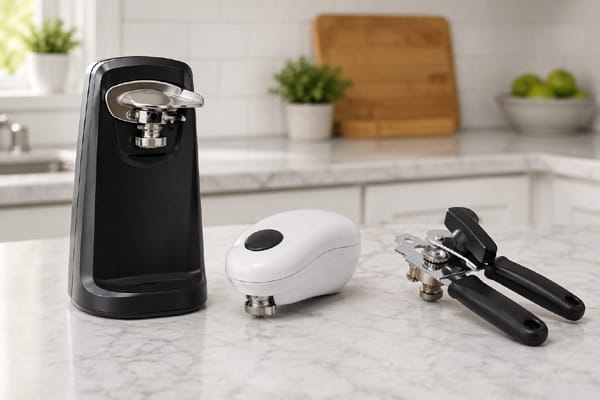
We looked at six decision factors: grip demand, wrist rotation, control size, stability, lid handling, and cleanup. We also gave extra weight to smooth-edge designs when manufacturers explicitly confirmed that feature.
However, we did not treat “electric” as automatically better. Some electric models still require careful alignment or continuous pressure. Likewise, a manual opener can work for mild arthritis if it reduces squeezing and uses a large, easy-turn control.
Because hand function varies, no single model will be easiest for everyone. If someone has major loss of hand function, an occupational therapist can help identify suitable assistive devices. The Arthritis Foundation recommends occupational-therapy guidance when individualized modifications or tools are needed.
1. Hamilton Beach SmoothTouch 76606ZA — Best Overall
The Hamilton Beach SmoothTouch 76606ZA earns our top spot because its design directly addresses two common frustrations: hard gripping and sharp lid edges.
Hamilton Beach says its large ergonomic lever requires little grip strength. In addition, the opener cuts along the side of the can instead of through the top. That leaves a smooth, touchable lid edge. It also works with regular and pop-top cans.
Best for: Seniors who have weak grip strength but can comfortably press and hold a large lever for several seconds.
Why we prefer it: It combines a stable countertop format, low grip demand, and smooth-edge cutting.
Skip it if: Holding a lever continuously is difficult, or you specifically need automatic shutoff.
2. Kitchen Mama Orbit One — Best for Minimal Continued Hand Use
The Kitchen Mama Orbit One becomes more interesting when continuous pressure is the main problem.
According to Kitchen Mama, the rechargeable opener starts with an on/off control, rotates around the can, and automatically stops after completing the opening cycle. It also includes a built-in lid remover.
As a result, the user does not need to keep squeezing handles, rotate a crank, or hold a lever through the entire cut. However, the opener still needs to be positioned correctly on top of the can.
Best for: People who can position and press a handheld device but want to avoid continued gripping or wrist rotation.
Why it stands out: Auto-stop operation removes an extra step that some “one-touch” openers still require.
Skip it if: Holding and aligning a handheld device is harder than using a fixed countertop appliance.
3. Zyliss EasiCan — Best Compact Electronic Alternative
The Zyliss EasiCan uses a simple electronic start-and-stop mechanism. Zyliss says the opener works with small, medium, and large cans and cuts from the side, leaving smooth edges.
The compact shape saves counter space and removes the repeated wrist cranking of a traditional manual opener.
Best for: Seniors with limited hand mobility who want a compact electronic opener.
Why we like it: It combines straightforward controls with smooth-edge cutting.
Skip it if: Pressing again to stop the opener is difficult or accurately positioning a handheld device is challenging.
4. Cuisinart Deluxe CCO-50N — Best Stable Countertop Design
Cuisinart’s Deluxe CCO-50N uses single-touch operation, a magnetic lid holder, and a sturdy base designed to resist sliding or tipping. The activation lever also removes for easier cleaning.
For reduced coordination, a fixed appliance may be easier than keeping a small handheld opener aligned.
Best for: Someone who wants a familiar upright electric opener with a stable base.
Why we like it: The single-touch control and magnetic lid holder simplify the basic opening sequence.
Keep in mind: Cuisinart does not describe this model as a smooth-edge side cutter. Therefore, do not assume the removed lid will have the same smooth edge as a verified side-cut model.
5. Proctor Silex Power Opener 75217G — Best for Easier Alignment
The Proctor Silex Power Opener addresses a less obvious accessibility problem: getting the can lined up correctly.
The manufacturer says a guide post helps users align cans. It also includes automatic shutoff, a removable washable cutting lever, and built-in cord storage.
For limited dexterity, easier alignment may matter more than extra accessories. Moreover, automatic shutoff simplifies the opening cycle.
Best for: Seniors who struggle to position a can correctly under a cutting mechanism.
Why we like it: The design focuses on basic usability rather than complicated controls.
Keep in mind: It is a conventional electric opener, not a manufacturer-confirmed smooth-edge side cutter.
6. OXO Good Grips Smooth Edge — Best Manual Pick for Mild Arthritis
If you want to avoid batteries and countertop appliances, the OXO Good Grips Smooth Edge is the strongest manual option in this guide.
OXO says it cuts below the can edge, leaving no sharp edges on the can or lid. Its side-wind knob is designed to require less force, while built-in lid pliers provide no-touch lid removal.
Still, the user must rotate the knob and release the mechanism after cutting.
Best for: Mild arthritis, reasonable wrist mobility, and shoppers who prefer a manual tool.
Why we like it: It reduces several drawbacks of conventional manual openers without requiring electricity.
Skip it if: Wrist rotation itself is painful. In that case, an electric model is the better starting point.
7. Zyliss Lock & Lift — Best Locking Manual Opener
The Zyliss Lock & Lift uses a locking mechanism that keeps the cutting wheel secured to the can. Therefore, the user does not have to maintain the same squeezing pressure through the entire opening process.
It also has an ergonomic turning knob and a built-in magnet for lifting the lid.
This design suits users who still have enough wrist movement to turn a manual knob.
Best for: Mild hand weakness and shoppers who want a simple manual backup.
Why we like it: The lock directly tackles the constant-squeeze problem found on many traditional openers.
Skip it if: Turning a knob aggravates hand or wrist discomfort.
Electric vs. Manual Can Openers for Arthritis
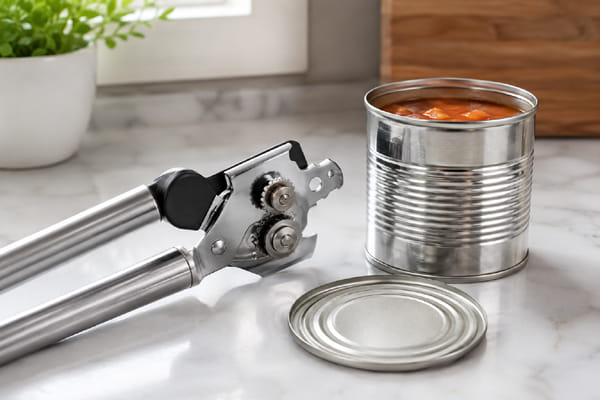
For significant grip weakness or painful wrist rotation, electric models are the better starting point. Electric can openers remove the repetitive cranking that manual tools require, and the Arthritis Foundation includes them among assistive kitchen appliances.
However, electric designs differ.
A countertop model favors stability. Therefore, it may work better for someone who struggles to hold small objects.
A handheld automatic opener favors storage and portability. Nevertheless, the user must usually position it accurately on the can.
Manual models make more sense for mild symptoms or no-power convenience. In that case, look for a large knob, non-slip grip, locking mechanism, or verified side-cut design.
What to Look for Before You Buy

First, identify the movement that causes the most trouble. Is it squeezing, turning, holding, aligning, or lifting the lid? That answer should drive the purchase.
Next, check the control. Large levers and broad buttons generally require less fine finger control than small knobs. Also, determine whether the control must be held down, pressed again to stop, or works with automatic shutoff.
Then, look at lid handling. A smooth-edge cutter, lid magnet, or lid-removal tool can reduce the need to pinch a loose metal lid.
Finally, think about where the opener will live. A countertop unit may be easy to operate but inconvenient if the user must lift it from a cabinet every day. In contrast, a handheld opener saves space but usually requires more precise placement.
Three Buying Mistakes That Make Arthritis-Friendly Openers Harder to Use
Do not buy a manual opener only because the package says “ergonomic.” A soft grip does not eliminate wrist rotation.
Also, do not assume “one-touch” means “press once and walk away.” Some products need another press to stop, while true auto-stop models end the cycle themselves.
Finally, do not overlook storage. A product is not convenient if the intended user cannot comfortably retrieve, lift, charge, or replace its batteries.
Frequently Asked Questions
What is the best can opener for seniors with arthritis?
Our research-based best overall pick is the Hamilton Beach SmoothTouch 76606ZA because it combines low grip demand, a large lever, a stable countertop format, and smooth-edge side cutting. However, someone who cannot comfortably hold a lever may prefer an auto-stop handheld design.
Are electric can openers easier for arthritis?
Often, yes. They remove the repetitive manual cranking required by traditional openers. However, the easiest design still depends on whether the user can hold a handheld device, press a control, or keep a can aligned. The Arthritis Foundation specifically recognizes electric can openers as useful assistive kitchen devices.
What type of can opener needs the least twisting?
Automatic electric openers require the least manual wrist rotation because the motor performs the cutting motion. However, compare whether the opener needs continuous pressure, a second stop press, or automatic shutoff.
Are smooth-edge can openers safer?
A verified side-cutting design can reduce exposure to the sharp cut lid edges produced by many conventional openers. For example, Hamilton Beach and OXO explicitly describe smooth-edge side cutting on the models featured here.
Is a manual can opener OK for mild arthritis?
Yes, if the user can still rotate the wrist comfortably. A larger knob, locking mechanism, and non-slip grip can make manual operation easier.
Should I buy a countertop or handheld electric opener?
Choose a countertop model when stability and simple positioning matter most. Choose a handheld model when storage and portability matter more and the user can position the device accurately.
Final Verdict
The best can opener for seniors with arthritis is the one that removes the specific hand movement causing the most difficulty.
For many users, the Hamilton Beach SmoothTouch 76606ZA is the best all-around starting point. For minimal continued hand involvement, the Kitchen Mama Orbit One deserves consideration. For mild arthritis and manual operation, the OXO Good Grips Smooth Edge is the better fit.
Instead of buying by brand name alone, match the opener to grip strength, wrist movement, control needs, lid handling, and storage. That decision is more useful than any generic “best” label.
As an Amazon Associate, I earn from qualifying purchases.