
As an Amazon Associate, I earn from qualifying purchases.
A vegetable chopper vs food processor may seem like a simple choice. After all, both can chop an onion. However, buying the wrong tool can leave you with uneven vegetables, unnecessary cleanup, wasted cabinet space, or an appliance you rarely use.
The decision becomes easier when you focus on five things: how much food you prepare, which cuts you need, how often you cook, how much cleanup you tolerate, and how much storage space you have.
Here is the fast answer:
Choose a vegetable chopper for small, everyday jobs such as onions, garlic, herbs, nuts, and quick salsa. It is compact, simple, and usually easier to clean.
Choose a full-size food processor if you regularly prepare larger batches or need to slice, shred, puree, mix, or knead.
Choose a mini food processor or electric chopper if you want powered chopping without the size and accessories of a full-size machine.
This guide goes beyond a basic feature list. It shows which appliance fits your actual cooking habits, which foods each one handles best, and when paying for a food processor makes sense.
Important note: This article compares the typical design and capabilities of these appliance categories. Features vary by model, so always check the manufacturer’s instructions and included accessories before buying.
Vegetable Chopper vs Food Processor: Quick Comparison
| Feature | Vegetable Chopper | Food Processor |
|---|---|---|
| Best for | Small, simple chopping jobs | Larger and more varied prep jobs |
| Typical size | Compact | Medium to large |
| Common capacity | About 3–5 cups | Commonly 6–16 cups |
| Main functions | Chop, mince, mix, sometimes puree | Chop, slice, shred, puree, mix, and sometimes knead or dice |
| Feed tube | Usually no | Usually yes |
| Slicing discs | Usually no | Often included |
| Cleanup | Fewer parts | More parts |
| Storage needs | Low | Moderate to high |
| Best household | One or two people, light cooking | Families, meal preppers, frequent cooks |
| Main advantage | Convenience | Versatility |
| Main limitation | Limited capacity and functions | More space, setup, and cleanup |
KitchenAid classifies food choppers as smaller tools, commonly around three to five cups, while residential food processors generally begin around six cups and can reach 16 cups or more. Food processors also tend to include feed tubes, discs, and additional accessories for slicing, shredding, dicing, or dough preparation.
First, Know What You Are Comparing
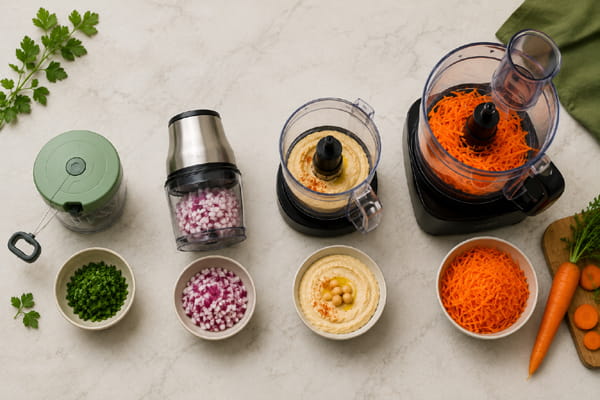
The terminology can be confusing because retailers do not always use the same product names.
Manual vegetable chopper
A manual vegetable chopper uses a pull cord, push mechanism, rotating handle, or grid-style blade. It does not need electricity.
It works best for small quantities and basic cuts. However, results depend on the design and how evenly the food is loaded.
Electric food chopper
An electric food chopper has a small bowl, motor, and multipurpose blade. Many models chop, mix, and puree.
These appliances are sometimes marketed as mini processors. However, they usually lack the feed tube and interchangeable slicing or shredding discs found on a full-size processor.
Mini food processor
A mini food processor sits between a chopper and a full-size model. It offers powered chopping in a compact body, but its accessories and functions vary widely.
Therefore, do not choose by product name alone. Check the bowl size, blade system, controls, feed tube, and included discs.
Full-size food processor
A full-size food processor usually has a larger work bowl, a feed tube, a chopping blade, and one or more slicing or shredding discs.
Depending on the model, it may chop, puree, slice, shred, mix dough, emulsify, or use a separate dicing attachment. Cuisinart’s current processor guides and product specifications illustrate how full-size machines can combine chopping blades with slicing and shredding discs, although exact capabilities differ by model.
The 30-Second Decision Test
Choose a vegetable chopper if at least four of these statements describe you:
- I usually cook for one or two people.
- I mainly chop onions, garlic, herbs, nuts, or peppers.
- I rarely need shredded cheese or sliced vegetables.
- I have limited cabinet or counter space.
- I want as few parts to wash as possible.
- I prepare small portions.
- I already own tools for slicing and grating.
- I want a simple appliance for quick daily prep.
Choose a food processor if at least four of these statements describe you:
- I regularly cook for several people.
- I prepare food in batches.
- I often shred cheese, cabbage, carrots, or potatoes.
- I want consistent slices.
- I make hummus, dips, dough, pastry, or nut-based mixtures.
- I want one machine to perform several prep tasks.
- I have space for the bowl, lid, blades, and discs.
- I will use it at least several times a month.
Still split evenly? A compact processor may offer the best middle ground.
9 Key Differences Between a Vegetable Chopper and Food Processor
1. Batch Size and Capacity
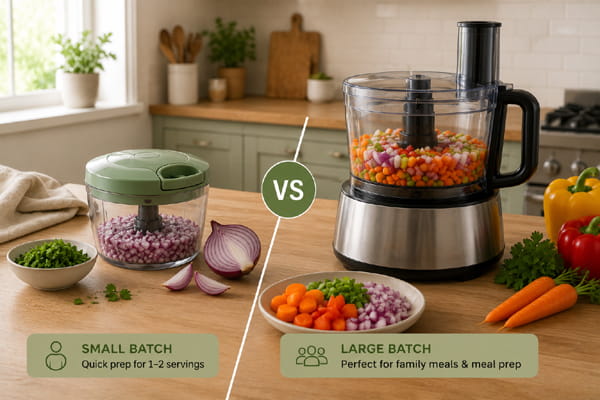
Capacity is one of the most important differences.
A vegetable chopper is useful when you need one onion, a few cloves of garlic, a handful of nuts, or a small serving of salsa. Its compact bowl can also process small amounts more effectively than an oversized work bowl.
In contrast, a food processor is better for family meals, batch cooking, or recipes that require several cups of ingredients.
Food choppers commonly fall near the three-to-five-cup range. Food processors often range from approximately six to 16 cups, although usable capacity and recommended fill limits vary by model and ingredient.
Winner for small portions: Vegetable chopper
Winner for large portions: Food processor
2. Chopping Control
Both appliances use blades to cut food. However, neither guarantees perfectly uniform cubes.
A chopper works well for rough or medium chopping. The longer you pull, press, or run the blade, the finer the food becomes.
A food processor can handle more food at once. However, its stronger motor may turn watery vegetables into a mushy mixture if you let it run continuously.
For onions, peppers, and herbs, short pulses usually provide better control than one long cycle. Stop and inspect the texture between pulses.
Winner for quick, small chopping: Vegetable chopper
Winner for high-volume chopping: Food processor
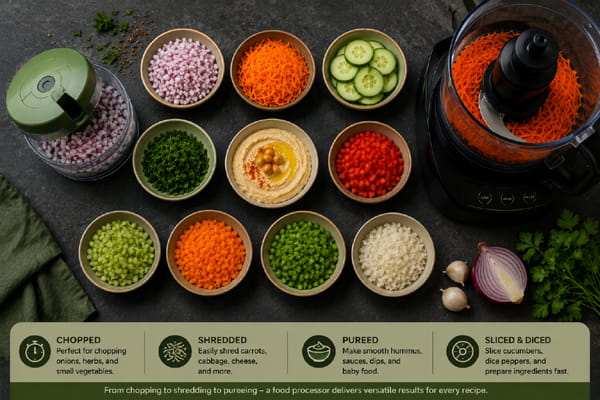
3. Slicing and Shredding
This category creates the clearest separation.
Most vegetable choppers cut food with a central spinning blade. They generally cannot create long shreds or repeated, even slices.
Many full-size food processors use separate discs for slicing and shredding. For example, current Cuisinart processors may include reversible shredding and slicing discs in addition to a universal blade.
A processor is therefore more useful for:
- Shredded cheese
- Sliced potatoes
- Shredded cabbage
- Sliced cucumbers
- Grated carrots
- Large salad preparations
However, never assume every processor includes these accessories. Check the box contents before purchase.
Winner: Food processor
4. Pureeing, Mixing, and Dough
Many electric choppers can puree cooked fruits, soft vegetables, dips, and dressings. For example, KitchenAid describes its compact choppers as suitable for chopping, mixing, and pureeing.
A food processor can often do the same jobs in larger quantities. In addition, some models include a dough blade or use the main blade for dough mixing.
Still, a food processor is not automatically a replacement for every blender or mixer. Thin liquids can leak from models not designed for them, while heavy dough may exceed a machine’s recommended load.
Always follow the model-specific manual.
Winner for small dips and sauces: Electric chopper
Winner for larger recipes and broader functions: Food processor
5. Prep Speed
A larger motor does not always mean a faster overall experience.
For one onion, a chopper may be faster because setup is simple. You add the food, chop it, and wash a few small parts.
For several pounds of vegetables, a food processor becomes more efficient. Its larger bowl and feed tube reduce repeated batches and manual cutting.
Therefore, think about total time:
Setup + cutting + processing + emptying + cleaning
A food processor often wins on large jobs. A chopper often wins on small ones.
6. Cleanup
A vegetable chopper generally has a bowl, lid, and blade. A food processor may include a work bowl, lid, pusher, blade, spindle, feed tube, and multiple discs.
As a result, the processor usually takes longer to wash and dry.
Before buying, check:
- Whether removable parts are dishwasher-safe
- Whether the lid has narrow channels
- Whether food collects around the spindle
- Whether the blade can be removed safely
- Whether accessories store inside the bowl
Always unplug an electric appliance before removing the blade. In addition, do not leave sharp blades hidden in a sink full of water.
FoodSafety.gov advises washing hands, utensils, cutting boards, and food-preparation surfaces as part of safe food handling. Fresh produce should be rinsed under running water; household cleaners should not be used on food.
Winner: Vegetable chopper
7. Counter and Cabinet Space
A vegetable chopper has a small footprint and fewer accessories. It is easier to store in an apartment, RV, dorm-style kitchen, or crowded cabinet.
A food processor requires space for more than its motor base. You may also need room for the bowl, lid, pusher, blade, discs, and optional attachments.
Before ordering, measure:
- Counter height below upper cabinets
- Cabinet shelf height
- Appliance width
- Storage space for accessories
- Clearance needed to remove the lid
Also consider accessibility. A useful appliance should be easy to reach. If it lives in the back of a high cabinet, you may rarely use it.
Winner: Vegetable chopper
[Internal link: Link “space-saving tools for small kitchens” to your apartment-kitchen article after publishing it.]
8. Cost and Long-Term Value
Vegetable choppers usually cost less because they are smaller and perform fewer jobs. Food processors generally cost more because they use larger motors, bowls, discs, and accessories.
However, purchase price does not determine value.
Use this simple formula:
Cost per use = Purchase price ÷ Estimated number of uses
A basic chopper used three times a week may offer better value than a premium processor used twice a year. On the other hand, a processor that replaces a grater, slicer, chopper, and manual dough-mixing routine may justify its higher price.
Also consider replacement parts. Check whether the manufacturer sells bowls, lids, blades, and discs separately.
Winner for lower initial cost: Vegetable chopper
Winner for multipurpose value: Food processor
9. Versatility
A chopper is a specialist. It focuses on a few common tasks and performs them with minimal setup.
A food processor is a generalist. Depending on the model, it can chop, puree, slice, shred, mix, emulsify, knead, or dice. KitchenAid and Cuisinart both distinguish full-size processors by their larger capacity, feed tubes, and additional blade or disc options.
Nevertheless, versatility only matters when you use it. Extra attachments provide no value if they stay in a drawer.
Winner: Food processor
Which Tool Works Best for Common Foods?
| Food or task | Better choice | Why |
|---|---|---|
| One onion | Vegetable chopper | Faster setup and cleanup |
| Several onions | Food processor | Larger capacity |
| Garlic and herbs | Vegetable chopper | Better suited to small quantities |
| Salsa | Either | Chopper for small batches; processor for larger batches |
| Hummus | Food processor | Better capacity and sustained processing |
| Nuts | Either | Depends on batch size and desired texture |
| Shredded cheese | Food processor | Requires a shredding disc |
| Sliced potatoes | Food processor | Slicing disc produces repeated slices |
| Coleslaw | Food processor | Faster shredding for cabbage and carrots |
| Breadcrumbs | Either | Chopper for a small batch; processor for more |
| Pie dough | Food processor | Only when the model supports the task |
| Pizza or bread dough | Food processor | Only within the manufacturer’s dough limits |
| Baby-food puree | Either | Depends on portion size and model instructions |
This table should help readers make a decision faster than a generic list of features.
Which One Is Better for Your Household?
One-person household
Start with a manual or electric chopper. It handles common tasks without taking over your kitchen.
Couple or small household
A chopper may still be enough. However, a compact processor becomes useful if you frequently shred, slice, or meal prep.
Family of four or more
A medium or full-size processor usually provides better capacity. It can reduce repeated batches when preparing salads, soups, casseroles, or weekly meals.
Apartment kitchen
Choose based on the jobs you cannot easily do by hand. A compact chopper is the safest space-saving option. A small processor makes more sense when its slicing and shredding functions can replace several separate tools.
Frequent meal prepper
A food processor is usually the stronger choice. Larger capacity and interchangeable discs save more time when preparing several meals at once.
Occasional cook
Choose the simpler option. A vegetable chopper has a lower storage and cleanup burden.
Do You Need Both?
Most kitchens do not need both at the beginning.
A chopper and processor make sense together only when you regularly perform both small and large tasks. For example, you might use a chopper for garlic and herbs during the week, then use a full-size processor for weekend meal prep.
Before buying both, ask:
- Will I use each one for a different job?
- Do I have accessible storage for both?
- Would a compact processor cover most of my needs?
- Am I solving a real cooking problem or simply adding another gadget?
[Internal link: Add a link from “another gadget” to your article Kitchen Gadgets Not Worth Buying: 15 Tools to Skip.]
Common Buying Mistakes
Choosing by wattage alone
Motor power matters, but it does not reveal the whole experience. Bowl design, blade shape, controls, stability, accessory quality, and manufacturer limits also affect performance.
Buying the largest bowl available
A large bowl helps with large recipes. However, it may handle tiny quantities less effectively and requires more storage.
Assuming “dishwasher-safe” means effortless cleaning
Some parts may be dishwasher-safe while the blade, lid, or motor base requires different care. Read the manual before washing anything.
Expecting a chopping blade to create perfect dice
A spinning blade chops food into smaller pieces, but it does not create identical cubes. Uniform dicing may require a model-specific dicing attachment.
Ignoring replacement parts
A damaged lid can make an otherwise functional appliance unusable. Check replacement-part availability before investing in an expensive model.
Paying for attachments you will not use
More accessories can look impressive. However, they also increase cost and storage needs.
What to Check Before You Buy
Use this checklist on any product page:
- Bowl capacity
- Minimum and maximum recommended batch
- Pulse control
- Feed tube size
- Included slicing or shredding discs
- Dough capability
- Dishwasher-safe components
- Replacement-part availability
- Warranty terms
- Cord storage
- Accessory storage
- Product dimensions
- Safety-lock design
- Manufacturer instructions for hot foods and liquids
Conversion box placement
Place a product-selection box here, but only after checking current products individually.
Suggested box headings:
- Best for Quick Daily Chopping
- Best Compact Electric Option
- Best for Small Apartments
- Best for Weekly Meal Prep
- Best Full-Size Option for Families
Do not publish ratings, prices, or “best” claims without verifying each product close to publication.
Vegetable Chopper vs Food Processor FAQs
Can a vegetable chopper replace a food processor?
A vegetable chopper can replace a food processor for small chopping, mincing, mixing, and limited pureeing tasks. However, it generally cannot replace a processor for repeated slicing, shredding, dough preparation, or larger batches.
Can a food processor chop onions?
Yes. Use short pulses and avoid filling the bowl beyond the manufacturer’s recommendation. Continuous processing can release more moisture and create an overly fine texture.
Is a vegetable chopper worth buying?
It is worth buying when you frequently chop small amounts and value fast cleanup. It provides less value when you already use a compact processor comfortably for the same jobs.
Is a food processor worth the extra cost?
A food processor may justify its higher cost when you regularly slice, shred, puree, or prepare large batches. It is less worthwhile when you only need occasional onion or herb chopping.
Which option is better for a small kitchen?
A vegetable chopper requires less storage. However, a compact processor may be more efficient when it replaces several separate prep tools.
Can a food processor dice vegetables?
A standard blade can chop vegetables into small pieces, but it may not create uniform cubes. Some processors support dedicated dicing attachments.
Which is easier to clean?
A vegetable chopper is usually easier because it has fewer parts. Still, lid design and blade shape can make a major difference between individual models.
Can I process hot food?
Do not process hot food unless the manufacturer specifically permits it. Heat and steam may create pressure or damage components not designed for high temperatures.
Is a manual chopper better than an electric chopper?
A manual chopper costs less, needs no outlet, and gives direct control. An electric model requires less physical effort and may handle repeated chopping more easily.
Final Verdict
The best choice in the vegetable chopper vs food processor debate depends on your routine, not the number of features printed on the box.
Choose a vegetable chopper when you prepare small portions, have limited space, and want quick cleanup. Choose a food processor when you cook in larger batches or regularly need slicing, shredding, pureeing, mixing, or dough functions.
A compact electric chopper or mini processor offers the most practical middle ground for many small US households.
Most importantly, buy the tool that matches the work you already do. A simple appliance used every week is more valuable than a versatile machine that never leaves the cabinet.
As an Amazon Associate, I earn from qualifying purchases.