
As an Amazon Associate, I earn from qualifying purchases.
A good countertop compost bin should make collecting food scraps easier without taking over your prep space or making the kitchen smell like yesterday’s dinner. For most compact kitchens, the best countertop compost bin for small kitchen use is a roughly 0.75- to 1.5-gallon container with a practical lid, an easy-clean interior, and an odor-control system that matches how often you empty it.
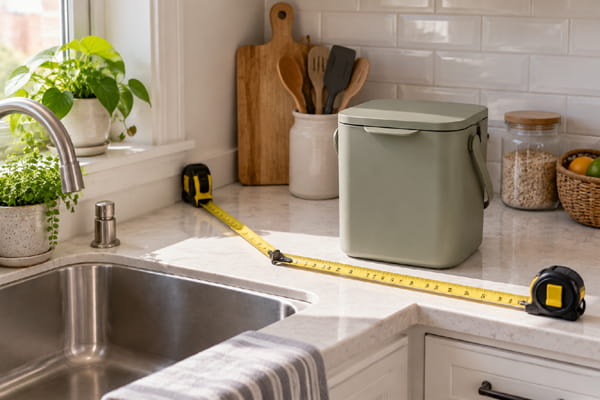
Our best all-around choice is the OXO Good Grips Easy-Clean Compost Bin. Its 0.75-gallon capacity, compact footprint, flip-up lid, carrying handle, and smooth interior make it particularly suitable for tight counters. OXO lists its dimensions at 6.6 × 6.4 × 7.5 inches.
If you need more capacity and prefer stainless steel with an activated-charcoal filter, the EPICA 1.3-Gallon Countertop Compost Bin is another strong option.
These bins are primarily food-scrap collectors, not devices that produce finished compost on your countertop. The collected material must eventually go to a backyard system, curbside organics collection, community program, or another accepted compost stream. EPA makes the same distinction between collecting or preprocessing scraps and actual composting.
Quick Answer: Which Countertop Compost Bin Is Best for a Small Kitchen?
For most compact kitchens:
- Best overall: OXO Good Grips Easy-Clean 0.75-Gallon Compost Bin
- Best filtered stainless steel: EPICA 1.3-Gallon Countertop Compost Bin
- Best premium design: Simplehuman 4L Compost Caddy
- Best for shallow counters: Joseph Joseph Compo 4
- Best ventilated design: Full Circle Fresh Air
- Best value charcoal-filter style: Utopia Kitchen 1.3-Gallon Compost Bin
- Best for frequent emptying: Brabantia Sort & Go 3L
No passive countertop bin can guarantee zero odor. Capacity, temperature, moisture, food type, cleaning, and how long scraps sit indoors all matter.
Comparison: 7 Countertop Compost Bins for Small Kitchens
| Product | Capacity | Odor-Control Approach | Small-Space Advantage | Best For |
|---|---|---|---|---|
| OXO Good Grips Easy-Clean | 0.75 gal | Closing lid | Approx. 6.6 × 6.4-inch footprint | Most small kitchens |
| EPICA Countertop Bin | 1.3 gal | Activated-charcoal filter + tight lid | Narrow round body | Filtered stainless steel |
| Simplehuman Compost Caddy | 4 L / 1.06 gal | Soft-seal lid | Can dock to compatible trash cans | Premium setups |
| Joseph Joseph Compo 4 | 4 L / 1.06 gal | Adjustable vent | Only 4.75 inches deep | Shallow counters |
| Full Circle Fresh Air | 1.5 gal | Ventilated airflow | Rectangular design | Larger scrap volume |
| Utopia Kitchen | 1.3 gal | Charcoal filter | Traditional compact pail | Value-focused buyers |
| Brabantia Sort & Go | 3 L / 0.8 gal | Frequent-emptying approach | About 5.5 inches deep | Daily emptying |
How We Chose These Countertop Compost Bins
Sweet-crush did not perform laboratory or hands-on testing for this guide. Recommendations are based on current manufacturer specifications, US retail information, counter footprint, capacity, lid design, odor-management method, cleaning requirements, portability, and suitability for limited kitchen space.
We also considered what current American buyers are likely to compare. Rather than assuming the biggest bin is best, each recommendation solves a particular small-kitchen problem.
1. OXO Good Grips Easy-Clean Compost Bin — Best Overall
OXO’s 0.75-gallon model is an excellent fit when every inch of counter space matters. The lid flips up for filling and folds down to help contain odors. Smooth interior walls help prevent food and liquids from accumulating in difficult crevices, while the removable lid and carrying handle simplify emptying.
The trade-off is capacity. Frequent cooks may need to empty it every day or two. In a compact kitchen, however, that can actually help control odor because scraps do not sit indoors as long.
Best for: one- or two-person households, apartments, and frequent emptying.
Potential drawback: too small for households generating substantial food scraps every day.
2. EPICA 1.3-Gallon Countertop Compost Bin — Best Filtered Stainless-Steel Pick
EPICA combines a 1.3-gallon stainless-steel body with an activated-charcoal filter and a covered design. Current US retail information lists the bin at approximately 7.16 inches in diameter and 11 inches tall.
The extra capacity makes it more practical than very small caddies if you cook frequently or do not take scraps outside after every meal.
A charcoal filter can help manage odor, but it does not eliminate the need to empty and wash the container.
Best for: shoppers who want stainless steel, more capacity, and replaceable filtration.
Potential drawback: replacement filters add ongoing maintenance.
3. Simplehuman 4L Compost Caddy — Best Premium Design
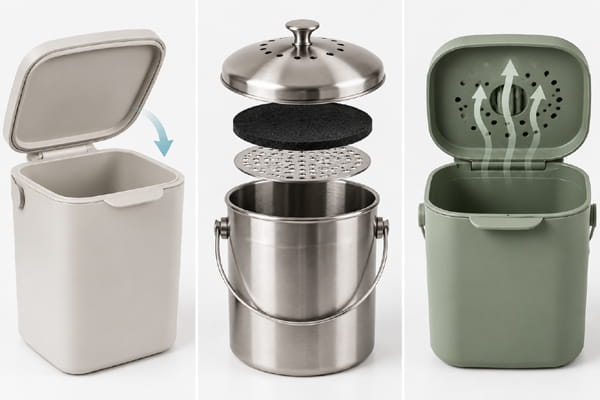
Simplehuman’s 4-liter Compost Caddy is designed to work either independently on a counter or dock magnetically to compatible Simplehuman trash cans. The company uses a soft-seal lid intended to let organics breathe while helping manage odors and pests. It also has a removable lid and smooth inner bucket for cleaning.
The brushed stainless-steel version was listed at $50 when checked, making it significantly more expensive than basic plastic or stainless-steel pails.
Best for: households already using Simplehuman waste systems or buyers prioritizing integrated design.
Potential drawback: premium price.
4. Joseph Joseph Compo 4 — Best for Shallow Counter Space
Counter depth can matter more than overall capacity in a small apartment kitchen. The Joseph Joseph Compo 4 holds 4 liters but measures only about 4.75 inches deep. It also comes with a door-mounting bracket, which can free the countertop completely.
Its adjustable vent can remain open to help reduce moisture and odor buildup or be closed to create more of an insect barrier. Official dimensions are approximately 7 inches high, 11.75 inches wide, and 4.75 inches deep.
Best for: shallow countertops, narrow ledges, or cabinet-door installation.
Potential drawback: its wide shape may not suit very narrow spaces.
5. Full Circle Fresh Air — Best Ventilated Option
The Full Circle Fresh Air uses a different odor-control strategy. Instead of simply sealing scraps inside, its patented design promotes airflow. Full Circle says this helps reduce odor and flies.
It offers a relatively generous 1.5-gallon capacity and measures about 11.38 × 8.5 × 9 inches. Its parts are top-rack dishwasher safe.
That larger footprint means it works better in a small kitchen with some spare counter width than in an extremely cramped kitchenette.
Best for: frequent cooks who prefer airflow-based odor management.
Potential drawback: larger counter footprint than the smallest picks.
6. Utopia Kitchen 1.3-Gallon Compost Bin — Best Value Charcoal-Filter Style
The Utopia Kitchen model follows a proven countertop-bin formula: stainless-steel construction, approximately 1.3 gallons of capacity, a lid, carrying handle, and replaceable charcoal filtration.
A US Walmart listing also identifies the 1.3-gallon capacity and extra charcoal filter.
It is a sensible choice for buyers who want the basic functionality of a filtered stainless-steel pail without paying for a magnetic docking or mounting system.
Best for: value-conscious shoppers who prefer traditional stainless-steel compost pails.
Potential drawback: check current seller, price, and availability before purchasing.
7. Brabantia Sort & Go 3L — Best for Frequent Emptying
The Brabantia Sort & Go takes a simpler approach. Its 3-liter, or roughly 0.8-gallon, capacity encourages regular emptying instead of storing several days of scraps.
It measures approximately 7.4 inches wide, 5.5 inches deep, and 7.1 inches high. Brabantia also provides a carrying handle, stay-open lid, smooth plastic construction, and a 10-year guarantee.
There is no charcoal filter, so this is best for households that can move scraps to an outdoor or municipal bin frequently.
Best for: daily or near-daily emptying and very limited counter depth.
Potential drawback: less suitable if scraps must remain indoors for several days.
How to Choose the Best Countertop Compost Bin for a Small Kitchen
Measure the Footprint, Not Just Capacity
A “small” bin can still be awkward if it is too deep. Measure the exact counter area where it will sit and check clearance for opening the lid beneath cabinets.
Match Capacity to Your Emptying Schedule
A 0.75- to 1-gallon bin can work well for one or two people who empty scraps frequently. Households cooking multiple meals daily may find 1.3 to 1.5 gallons more practical.
Do not automatically buy the largest option. More capacity also makes it easier to leave scraps sitting longer.
Compare Odor-Control Systems
Charcoal filters absorb some odors but eventually require replacement.
Closing or sealed lids keep odors contained but may also retain moisture.
Ventilated systems increase airflow and attempt to reduce wet conditions.
Small-capacity bins rely primarily on frequent emptying.
Make Cleaning Easy
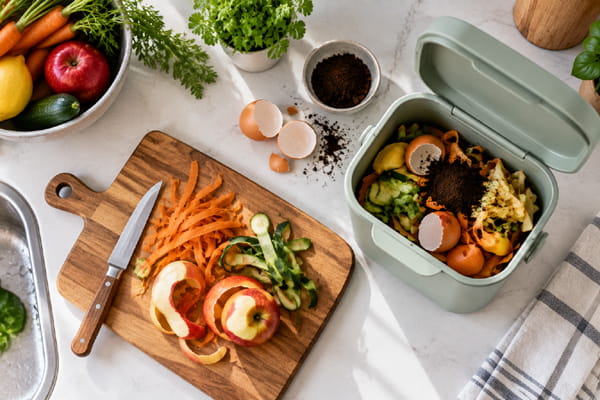
Food residue collects quickly around lids and rims. Smooth interiors, removable lids, removable buckets, and dishwasher-safe parts reduce the effort required to keep a food-scrap bin hygienic.
What Can You Put in a Countertop Compost Bin?
What belongs in the bin ultimately depends on where its contents are going.
EPA guidance for home composting generally distinguishes common backyard compost materials from items such as meat, bones, and dairy.
Municipal programs can be different. New York City, for example, accepts all food scraps in its curbside program, including meat, bones, shells, and dairy.
Therefore, follow your local collection program rather than relying only on a generic list from a compost-bin manufacturer.
How to Reduce Odor and Fruit Flies
Empty food scraps regularly, particularly during warm weather. Clean residue from the rim and underside of the lid, avoid leaving excessive liquid in the bottom, and change charcoal filters according to manufacturer guidance.
If you use compostable liners, confirm that your destination compost facility accepts them. A product labeled “compostable” is not automatically accepted by every local program.
One common mistake is buying a large bin and waiting until it is completely full. For many small kitchens, a smaller container emptied more frequently is easier to keep clean.
Frequently Asked Questions
Do countertop compost bins actually compost food?
Usually not. Most are temporary food-scrap collection containers. The contents still need to enter an actual composting system.
Do countertop compost bins smell?
They can. A good lid, charcoal filtration, airflow, frequent emptying, and regular cleaning can reduce odor, but no passive bin guarantees zero smell.
What size compost bin is best for a small kitchen?
About 0.75 to 1.3 gallons is practical for many compact kitchens. Frequent cooks may prefer up to approximately 1.5 gallons.
Is stainless steel better than plastic?
Not necessarily. Stainless steel is durable and visually discreet, while plastic can be lightweight and shaped into more space-efficient designs. Lid construction and cleanability may matter more.
Do I need a charcoal filter?
No. Charcoal can help absorb odor, but a well-designed filter-free bin can work effectively if it is emptied regularly.
Can I use compostable bags?
Yes only when your final composting service accepts them. Requirements vary between municipal and private programs.
How often should I empty my countertop compost bin?
Empty it before excessive moisture, odor, or insects become a problem. Depending on household size and temperature, that may mean daily or every few days.
Final Verdict
For the best countertop compost bin for small kitchen use, begin with your available counter footprint and how often you can realistically empty food scraps.
The OXO Good Grips Easy-Clean 0.75-Gallon Compost Bin is our best all-around option because it is compact, uncomplicated, and easy to clean. Choose EPICA if you want more capacity with charcoal filtration, or the Joseph Joseph Compo 4 if limited counter depth is your biggest concern.
Before buying, measure your available space and check the food-scrap rules for your local compost program.
The best compost bin is ultimately the one that makes separating food scraps simple enough to become part of your everyday kitchen routine.
As an Amazon Associate, I earn from qualifying purchases.