As an Amazon Associate, I earn from qualifying purchases.
A well-working kitchen does not need to be packed with gadgets. For most home cooks, a small group of reliable accessories does far more than a drawer full of trendy tools.
The best kitchen accessories make daily cooking easier, cleaner, and less stressful. They help with prep, improve consistency, save time, and support the routines people actually follow at home. Whether you are setting up a new kitchen, replacing worn-out basics, or simply trying to cook with less hassle, the right accessories can make a noticeable difference.
This guide focuses on practical kitchen tools that earn their place. These are not novelty items or one-use gadgets. They are the everyday accessories that support real cooking.
Why the Right Kitchen Accessories Matter
People often think better cooking starts with expensive appliances or chef-level equipment. In reality, everyday cooking usually depends on simple tools that work well and hold up over time.
A stable cutting board makes prep safer. A good spatula makes stirring and scraping easier. Measuring spoons help avoid small mistakes that can affect a recipe. Storage containers keep leftovers organized and reduce food waste. None of these tools are glamorous, but they make a kitchen work better.
That is what matters most. Useful kitchen accessories do not need to impress anyone. They need to make cooking feel smoother on a normal Tuesday night when dinner needs to get on the table fast.
What Makes a Kitchen Accessory Worth Buying?
Before buying any kitchen accessory, it helps to think beyond appearance. A product can look attractive online and still be annoying to use in real life.
The best kitchen accessories usually have a few qualities in common.
They solve a real everyday problem
A useful accessory helps with tasks that happen often, such as chopping vegetables, measuring ingredients, draining pasta, stirring sauces, or storing leftovers. If a tool supports something you already do every week, it is more likely to be worth buying.
They are easy to clean
This matters more than many people expect. A tool that is hard to wash often ends up unused. The best accessories are simple to rinse, wipe, or place in the dishwasher without a lot of extra effort.
They are durable enough for regular use
Flimsy tools usually create frustration. A kitchen accessory should be sturdy enough to handle repeated use without bending, warping, cracking, or losing its shape too quickly.
They save time without creating clutter
The best tools simplify cooking. They do not add extra steps or take up unnecessary space. In most kitchens, versatility matters more than novelty.
Best Kitchen Accessories for Everyday Cooking
Below are the kitchen accessories that tend to be the most useful in real homes. These tools support prep, cooking, serving, and storage without turning the kitchen into a cluttered space.
1. Cutting Boards
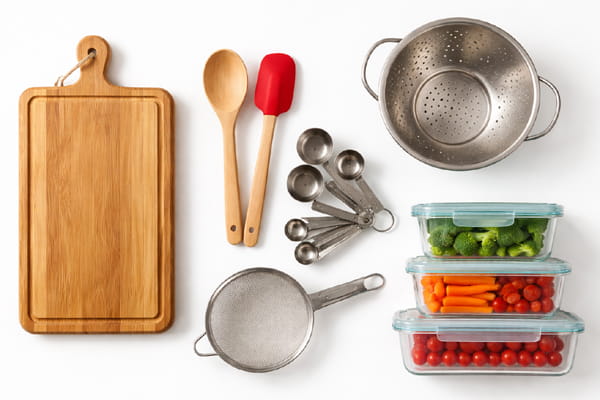
A good cutting board is one of the most basic and most important tools in any kitchen. In fact, having more than one is even better. Many people like to keep one board for produce and another for raw meat, fish, or ingredients with strong odors such as onions and garlic.
That simple setup helps keep prep more organized and can make cooking feel cleaner and more efficient. It also reduces the need to stop and wash the same board in the middle of a meal.
Wood and bamboo cutting boards are popular because they are sturdy and attractive, while plastic boards are easy to sanitize and often more affordable. No matter which material you choose, stability matters. A board that slides during prep is frustrating and less safe.
A cutting board may not seem exciting, but it is one of the accessories most home cooks use every single day.
2. Measuring Cups and Measuring Spoons
Even people who cook by instinct need measuring tools sometimes. They are essential for baking, but they are also helpful for sauces, rice, marinades, dressings, and portioning ingredients with more consistency.
A proper set of measuring cups and spoons removes guesswork from recipes. That is especially useful for beginners, but even experienced cooks benefit from having reliable measurements when trying new dishes or repeating a recipe that turned out well the first time.
Stainless steel sets usually last longer and resist bending better than very cheap plastic ones. Clear markings also matter, because faded labels make tools less useful over time.
These are small kitchen accessories, but they are among the most practical tools to keep close at hand.
3. Silicone Spatula
A silicone spatula is one of the most versatile tools in the kitchen. It stirs sauces, folds batter, scrapes bowls, mixes soft ingredients, and helps you get the last bit of food out of jars or containers without waste.
One reason people use spatulas so often is that they are gentle on cookware, especially nonstick pans and mixing bowls. They are also easy to handle and simple to clean.
A good silicone spatula should feel solid, flexible, and heat-resistant. Cheap versions can wear out faster or separate over time, so it is worth choosing one that feels durable.
For something so simple, a spatula ends up doing a surprising amount of work.
4. Wooden Spoon
There is a reason wooden spoons remain a kitchen staple. They are comfortable to hold, strong enough for daily cooking, and gentle on pots and pans. They work especially well for stirring soups, sauces, pasta, grains, and one-pan meals.
Unlike some metal utensils, wooden spoons do not scratch cookware, and they stay pleasant to use even during longer cooking sessions. Many home cooks reach for them without even thinking because they feel familiar and dependable.
They do need proper drying after washing, and they should be replaced if they crack or hold strong odors. Still, they remain one of the simplest and best everyday tools in a working kitchen.
5. Fine Mesh Strainer
A fine mesh strainer is one of those accessories that often becomes more useful than expected. It can rinse rice, wash berries, strain tea, sift flour, remove seeds or pulp from sauces, and drain small ingredients that would fall through a regular colander.
That range of uses makes it one of the most practical tools for both cooking and baking. It also stores easily, which is a big advantage in smaller kitchens.
If you only think of a strainer as something for one job, it is easy to underestimate. In reality, it is the kind of tool that quietly supports all kinds of prep work.
6. Kitchen Shears
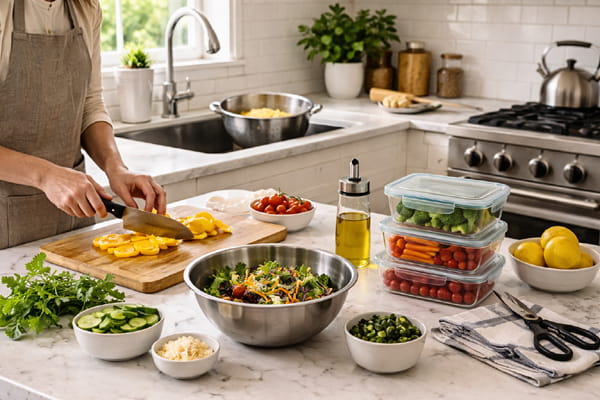
Kitchen shears do not always get enough credit, but they can save a lot of time during meal prep. They are useful for trimming herbs, cutting parchment paper, opening food packaging, slicing green onions, portioning some meats, and handling quick kitchen tasks that do not always require a knife and board.
That convenience is what makes them valuable. Small tasks feel faster and cleaner when you can reach for shears instead of setting up another cutting surface.
The best kitchen shears feel sturdy and come apart for easier cleaning. That is especially important if they are used on raw meat. Like many good kitchen tools, their value shows up in the way they simplify routine jobs.
7. Mixing Bowls With Lids
Mixing bowls are some of the hardest-working accessories in any kitchen. They are useful for mixing ingredients, marinating proteins, tossing salads, holding chopped vegetables, prepping baking ingredients, serving side dishes, and storing leftovers.
Bowls with lids are even more useful because they move easily from prep to storage. That means fewer dishes, fewer extra containers, and a more organized workflow while cooking.
Nesting sets are especially good for smaller kitchens because they save cabinet space. Stainless steel, glass, and BPA-free plastic all work well depending on what you prefer.
A good bowl set does not just help with one part of cooking. It supports the whole process from beginning to end.
8. Colander or Over-the-Sink Strainer
Draining pasta, rinsing beans, washing vegetables, and cleaning fruit are common kitchen tasks, and a reliable colander helps with all of them. It is one of those tools that may not stand out until you realize how often you use it.
Traditional colanders work well in most kitchens, while over-the-sink strainers can be especially useful in smaller spaces where counter space is limited. Both options help keep prep simple and reduce mess around the sink.
When choosing one, durability matters. Stainless steel options often last longer, while plastic versions are lightweight and affordable but may stain more easily over time.
For anyone who cooks pasta, grains, or fresh produce regularly, this is an everyday essential.
9. Oil Dispenser or Pour Bottle
A standard oil bottle is not always the easiest thing to use while cooking. It can be heavy, awkward to control, and messy around the spout. A smaller oil dispenser or pour bottle makes daily cooking much easier.
It gives you better control while sautéing, roasting, or dressing food, and it helps keep the area around the stove cleaner. For many people, it also helps with portion awareness because it is easier to pour a small amount instead of accidentally using too much.
This may seem like a minor upgrade, but it improves the cooking experience in a simple and practical way. The key is choosing one that pours cleanly and is easy to wash.
10. Food Storage Containers
Cooking does not stop when the meal is finished. Leftovers need to be stored, chopped ingredients need to be organized, and meal prep items need a place in the fridge. A good set of food storage containers makes all of that easier.
Matched containers help reduce clutter, make the fridge look more organized, and lower the chances of food being forgotten and wasted. They are useful for storing sauces, cooked grains, vegetables, fruit, lunches, and leftover meals.
Glass containers are excellent for durability and reheating, while quality plastic containers are lighter and easier to carry. The most important thing is that the lids fit securely and the containers are practical for everyday use.
This is one of the smartest kitchen basics to invest in because it supports both cooking and cleanup.
11. Instant-Read Thermometer
Not every kitchen accessory gets used every single day, but some tools are worth having because of the confidence they provide. An instant-read thermometer is one of them.
It helps you check doneness accurately when cooking chicken, beef, seafood, casseroles, and even baked goods. Instead of cutting into food and guessing, you can check the temperature and know whether it is ready.
That accuracy helps prevent overcooking and undercooking. It is especially useful for home cooks who want better results with proteins or want to feel more confident preparing meals for family and guests.
For many people, this becomes one of those tools they wish they had bought sooner.
Which Kitchen Accessories Should You Buy First?
If you are building a kitchen from scratch, it helps to start with the tools that cover the most tasks. A smart starter set usually includes:
- cutting boards
- measuring cups and spoons
- a silicone spatula
- a wooden spoon
- mixing bowls with lids
- a fine mesh strainer
- a colander
- kitchen shears
- food storage containers
That group handles prep, cooking, draining, mixing, and storing food without wasting money on low-value gadgets. Once those basics are covered, you can add other items based on your habits.
Best Choices for Different Types of Home Cooks
For beginners
Stick with simple, versatile tools that are easy to use and hard to outgrow. Measuring tools, cutting boards, bowls, spatulas, and storage containers are strong first choices.
For busy families
Prioritize accessories that save time and support larger volumes of cooking. Lidded bowls, larger colanders, kitchen shears, and organized storage sets are especially useful.
For small kitchens
Choose stackable or nesting items whenever possible. In tight spaces, storage matters almost as much as function.
For regular home cooks
Upgrade the tools you use most often. Better daily-use accessories usually improve the cooking experience more than buying new specialty gadgets.
Common Mistakes to Avoid
One common mistake is buying tools because they look good online without thinking about how they will work in everyday life. Another is filling drawers with one-use gadgets that rarely come out after the first week.
It is also easy to ignore cleaning and storage. Even a well-designed tool loses value if it is difficult to wash or takes up too much space.
The smartest approach is to buy for routine, not impulse. Choose accessories that support the way you actually cook, not the way you imagine you might cook once in a while.
Final Verdict
The best kitchen accessories are not the trendiest ones. They are the tools that make everyday cooking easier, faster, cleaner, and more organized.
A practical kitchen does not need to be complicated. With a few strong basics, such as cutting boards, measuring tools, spatulas, bowls, strainers, shears, and storage containers, most home cooks can handle daily meals with less stress and less mess.
If a kitchen accessory helps you prep faster, cook more smoothly, or store food more effectively, it is worth keeping. That is the standard that matters most.
FAQs
What are the most essential kitchen accessories for everyday cooking?
The most essential accessories usually include cutting boards, measuring cups and spoons, a silicone spatula, wooden spoon, mixing bowls, a colander, kitchen shears, and food storage containers.
Are affordable kitchen accessories worth buying?
Yes. Many affordable kitchen tools are worth buying if they are made from durable materials and designed for regular use. Price matters less than function and quality.
Which kitchen accessories are best for small kitchens?
Nesting bowls, stackable storage containers, over-the-sink strainers, and multi-use tools are usually the best options for smaller kitchens.
What kitchen tools should first-time cooks buy first?
Start with the basics that support daily cooking, such as a cutting board, measuring tools, mixing bowls, a spatula, wooden spoon, colander, and food storage containers.
How do I avoid buying unnecessary kitchen gadgets?
Focus on tools you will use often. If an item solves a very specific problem that rarely comes up, it usually does not need to be a priority.
As an Amazon Associate, I earn from qualifying purchases.