
As an Amazon Associate, I earn from qualifying purchases.
A shorter blade is not automatically a better knife for smaller hands. The handle can still feel too thick, the bolster may crowd your pinch grip, or the knife may be heavier than expected.
The best chef knife for small hands should combine a manageable 6- to 7-inch blade with a comfortable handle, useful knuckle clearance, controlled balance, and a weight that does not tire your wrist during everyday prep.
Based on current US availability, official specifications, and small-hand-focused design features, the ZWILLING Pro 7-Inch Slim Chef’s Knife is our best overall choice. The Victorinox Fibrox 6-Inch Chef’s Knife is the best lightweight budget option, while the WÜSTHOF Classic 6-Inch Half Bolster is our preferred traditional German-style knife.
How we researched: This is a specification-based buying guide. We did not personally test every knife. We compared official dimensions, blade profiles, weights where disclosed, handle designs, bolster styles, materials, care requirements, warranties, prices, and current US availability. Prices were checked on July 31, 2026, and may change.
Quick Recommendations
- Best overall: ZWILLING Pro 7-Inch Slim
- Best lightweight budget knife: Victorinox Fibrox 6-Inch
- Best traditional German knife: WÜSTHOF Classic 6-Inch Half Bolster
- Best premium Japanese-style knife: Shun Classic Blonde 6-Inch
- Best slim metal handle: Global G-58 6-Inch
- Best nonslip handle: Mercer Genesis Short Bolster 6-Inch
- Best compact German alternative: Messermeister Meridian Elite 6-Inch
At-a-Glance Comparison
| Knife | Blade Length | Published Weight | Handle/Grip Feature | Recent Official Price |
|---|---|---|---|---|
| ZWILLING Pro Slim | 7.09 in. | About 8.2 oz. | Medium handle, curved bolster | $159.99 |
| Victorinox Fibrox | 5.9 in. | 2.8 oz. | Textured nonslip TPE | $50 |
| WÜSTHOF Classic Half Bolster | 6 in. | Not listed | 4.4-in. handle, half bolster | $135 |
| Shun Classic Blonde | 6 in. | 4.7 oz. | 4.6-in. D-shaped Pakkawood | $169.95 |
| Global G-58 | 6 in. | Not listed | Slim dimpled steel handle | Check current price |
| Mercer Genesis Short Bolster | 6 in. | Not listed | Nonslip Santoprene | Varies by retailer |
| Messermeister Meridian Elite | 6.18 in. | Not listed | Traditional triple-rivet handle | Check current price |
The manufacturer does not publish every measurement for every knife. Missing data is identified rather than estimated.
How We Chose the Best Chef Knife for Small Hands
Blade Length
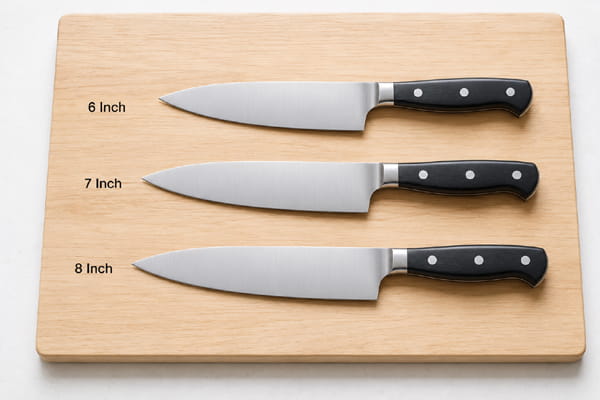
A standard 8-inch chef’s knife offers useful reach, but it can feel cumbersome during small-batch prep. A 6-inch knife is easier to maneuver around garlic, shallots, herbs, and smaller vegetables. A slim 7-inch blade offers additional reach without feeling as large as many standard knives.
Blade length remains a starting point—not the complete answer.
Handle Fit
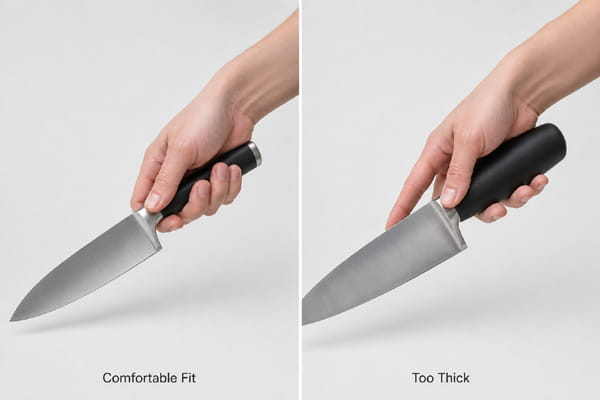
Your fingers should wrap around the handle without stretching or squeezing excessively. A handle that is too thick may make the knife rotate in your hand. A handle that is too short can crowd the pinky.
A pinch grip should also feel natural. Your thumb and index finger should rest near the heel of the blade without being forced against a sharp or bulky bolster.
Weight and Balance
An ultralight knife feels quick and agile. However, some cooks prefer a moderately weighted forged knife because the extra mass helps guide cuts.
The better choice is the knife that feels controlled while your grip remains relaxed. A blade-heavy knife may tire the wrist, while an overly handle-heavy knife can feel disconnected from the cutting edge.
Knuckle Clearance
Short utility knives are not always substitutes for chef’s knives. A proper chef’s knife has enough blade height to keep your knuckles from striking the cutting board.
That is why every recommendation here uses a chef-style blade rather than a narrow utility profile.
1. ZWILLING Pro 7-Inch Slim — Best Overall
The ZWILLING Pro Slim stands out because the manufacturer specifically designed it with a smaller blade profile, lighter construction, and medium-size handle. Its 7.09-inch blade provides more cutting length than a compact 6-inch knife, yet it remains smaller than a standard 8-inch model.
The official specification lists a weight of 0.51 pounds, or approximately 8.2 ounces. ZWILLING also states that the blade profile is 9% smaller and the knife is 24% lighter than its original Pro knives. Its curved bolster supports a pinch grip and allows the cutting edge to remain accessible near the heel.
Why it fits: It combines a medium handle, smaller blade profile, and full-size versatility.
Best for: Home cooks who want one primary knife for vegetables, herbs, boneless meat, and everyday preparation.
Main tradeoff: It is heavier and more expensive than the Victorinox or Shun.
Skip it if: You want the lightest possible knife or strongly prefer a 6-inch blade.
2. Victorinox Fibrox 6-Inch — Best Lightweight Budget Pick
At only 2.8 ounces, the Victorinox Fibrox is by far the lightest knife in this comparison. Its blade measures 5.9 inches, while the textured TPE handle is designed to provide a steady, nonslip grip.
The official US listing showed a $50 price, Swiss construction, a lifetime warranty, and dishwasher-safe labeling. Nevertheless, hand-washing is still the gentler option for preserving the edge and handle.
Why it fits: The short blade and extremely low weight make it easy to maneuver.
Best for: Beginners, occasional cooks, budget shoppers, and people who dislike heavy forged knives.
Main tradeoff: The molded handle looks utilitarian, and the stamped blade does not provide the substantial feel of a forged knife.
Skip it if: You prefer a premium finish, decorative handle, or heavier Western balance.
3. WÜSTHOF Classic 6-Inch Half Bolster — Best Traditional German Pick
The WÜSTHOF Classic Half Bolster offers a compact 6-inch blade, a 4.4-inch handle, forged construction, and 58 HRC steel. Unlike the standard full-bolster version, its reduced bolster lowers weight and exposes more of the cutting edge.
WÜSTHOF says the half bolster makes the knife easier to handle and allows the entire blade to be sharpened more easily. The blade is 1.6 inches high, which should provide better board clearance than a narrow utility knife. Its official US price was $135.
Why it fits: It delivers familiar German-knife balance in a shorter, less bolster-heavy format.
Best for: Cooks who use rocking motions and prefer a solid forged knife.
Main tradeoff: WÜSTHOF does not publish the knife’s total weight on this product page.
Skip it if: You prefer a thin, ultralight Japanese-style blade.
4. Shun Classic Blonde 6-Inch — Best Premium Japanese-Style Pick
The Shun Classic Blonde pairs a 6-inch blade with a published weight of 4.7 ounces. Its 4.6-inch D-shaped Pakkawood handle is designed for both left- and right-handed users.
The knife uses a VG-MAX cutting core, Damascus cladding, a 16-degree edge on each side, and a blade height of 1.6 inches. Shun describes it as smaller, lighter, and more maneuverable while retaining enough blade width for knuckle clearance. The official sale price was $169.95.
Why it fits: It combines low weight, compact length, useful blade height, and a refined handle.
Best for: Cooks who prefer precision slicing, push cuts, and careful maintenance.
Main tradeoff: The thinner, harder edge requires more care than a softer budget workhorse.
Skip it if: You regularly cut bones, frozen foods, or use glass cutting boards.
5. Global G-58 6-Inch — Best Slim Metal Handle
The Global G-58 uses a seamless stainless-steel design with a hollow handle filled for balance. Its 6-inch blade is made from CROMOVA 18 steel and hardened to approximately 56–58 HRC.
The dimpled handle is slimmer than many bulky Western handles and is intended to provide a slip-resistant grip. Because the knife has no separate scales or large bolster, it can feel especially direct in the hand.
Why it fits: The narrow, seamless handle and compact blade offer a different fit from thick triple-rivet designs.
Best for: Cooks who like modern styling, slim handles, and a direct blade-to-hand feel.
Main tradeoff: Metal handles are polarizing and may feel less cushioned than polymer or wood.
Skip it if: You dislike hard metal grips or prefer a deeply contoured handle.
6. Mercer Genesis Short Bolster 6-Inch — Best Nonslip Grip
The Mercer Genesis Short Bolster combines a 6-inch forged German-steel blade with an ergonomic Santoprene handle. Mercer describes the material as comfortable and nonslip, including when hands are wet.
Its shortened bolster exposes the full edge for easier sharpening, while the blade uses a 15-degree edge and is rated at 56 HRC, plus or minus one. The model was listed as in stock on Mercer’s current cutlery pages.
Why it fits: The secure handle reduces the need to squeeze tightly, and the short bolster improves pinch-grip access.
Best for: Busy home cooks who value grip security and practical materials.
Main tradeoff: The handle is functional rather than elegant, and official direct pricing is not displayed.
Skip it if: You want premium wood, Damascus cladding, or an ultralight stamped blade.
7. Messermeister Meridian Elite 6-Inch — Best Compact German Alternative
The Messermeister Meridian Elite uses a 6.18-inch blade, 58 HRC German steel, a 15-degree edge, and an overall length of 11.3 inches. Messermeister specifically describes the knife as suitable for smaller hands, tight countertops, and cooks seeking more control.
Its traditional triple-rivet handle and forged construction provide a familiar Western feel without requiring an 8-inch blade.
Why it fits: The blade is compact, but it retains the profile and balance of a full chef’s knife.
Best for: Cooks who want an alternative to WÜSTHOF or ZWILLING.
Main tradeoff: The manufacturer does not publish total weight or complete handle dimensions.
Skip it if: You need fully documented weight measurements before buying.
How to Check Fit Before Keeping a Knife
Hold the knife in a relaxed pinch grip. Your thumb and index finger should control the blade while the remaining fingers rest naturally around the handle.
Next, make several slow chopping and rocking motions without food. Watch for these signs:
- Your wrist remains neutral.
- Your knuckles clear the board.
- Your pinky stays comfortably on the handle.
- The bolster does not dig into your index finger.
- You do not need to squeeze to prevent rotation.
- The blade does not pull your wrist forward.
When ordering online, choose a seller with a reasonable return policy. Knife fit is personal, and specifications cannot fully predict comfort.
Common Buying Mistakes
Do not buy only by blade length. A short blade with a thick handle may still feel oversized.
Do not assume that a knife marketed toward women automatically fits small hands. Hand dimensions and grip preferences vary regardless of gender.
Do not focus on Rockwell hardness alone. Hardness affects edge behavior, but it does not tell you whether the handle, balance, or blade profile will feel comfortable.
Finally, avoid buying a large knife block before choosing your preferred chef’s knife. One well-fitting knife is more useful than several knives that remain unused.
Care and Safety
Hand-wash your knife with mild soap and dry it immediately. Store it in a blade guard, in-drawer organizer, knife block, or suitable magnetic strip.
Use wood or knife-friendly synthetic cutting boards. Avoid glass, stone, or metal cutting surfaces because they can damage the edge.
A sharp knife still requires care, but a dull knife can also become unpredictable because it needs more force to cut. Hone or sharpen according to the manufacturer’s guidance.
Frequently Asked Questions
Is a 6-inch chef’s knife good for small hands?
Yes. A 6-inch blade is easier to maneuver than many 8-inch knives while remaining large enough for most everyday preparation.
What is the best chef knife for small hands?
The ZWILLING Pro 7-Inch Slim is our best overall choice because it combines a smaller blade profile, medium handle, useful length, and pinch-grip-friendly bolster.
What is the best budget option?
The Victorinox Fibrox 6-Inch is the best low-cost choice. It weighs only 2.8 ounces and has a textured nonslip handle.
Is a 7-inch knife too large?
Not necessarily. A slim 7-inch knife can provide more reach than a 6-inch model without feeling as bulky as a standard 8-inch chef’s knife.
Are Japanese knives better for small hands?
Some are because they tend to be thinner and lighter. However, handle dimensions, balance, blade height, and cutting style matter more than country of origin.
Is a small chef’s knife suitable for large vegetables?
It can handle most daily prep, but a 6-inch blade may feel limited when cutting large cabbage, squash, watermelon, or large roasts.
Should I choose a full or half bolster?
A half bolster usually reduces weight, improves pinch-grip access, and makes sharpening near the heel easier. A full bolster may feel more protective but adds material and weight.
How often should I sharpen the knife?
Sharpen it when honing no longer restores clean cutting. Frequency depends on the steel, cutting board, technique, and how often the knife is used.
Final Verdict
The ZWILLING Pro 7-Inch Slim is the best chef knife for small hands when you want one versatile, fit-focused everyday knife. The Victorinox Fibrox 6-Inch is the lightest and most affordable choice, while the WÜSTHOF Classic Half Bolster 6-Inch offers a traditional forged feel in a more manageable format.
Choose the Shun for premium lightweight precision, the Global for a slim metal handle, the Mercer for grip security, or the Messermeister for another compact German option.
Before buying, compare more than blade length. The right knife should let your hand remain relaxed while the blade feels predictable, balanced, and easy to guide.
As an Amazon Associate, I earn from qualifying purchases.